
Last Connect
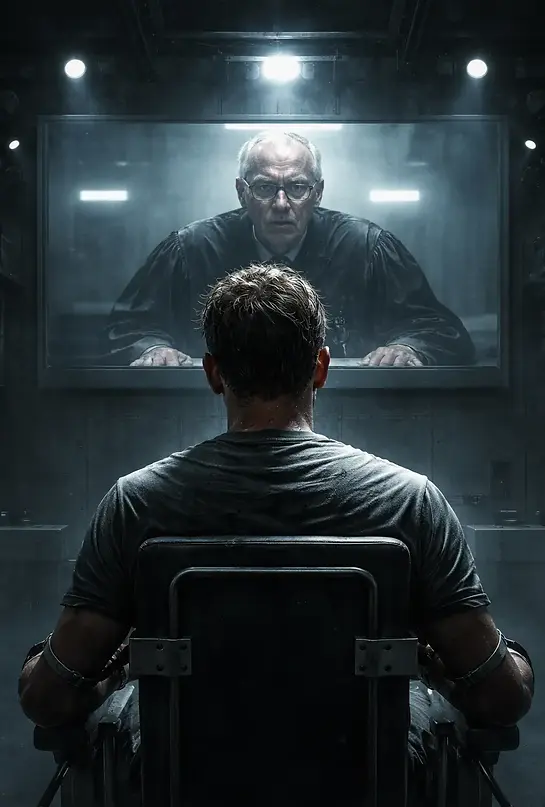
The air in the cell does not move.
A vent sits above me, but whatever passes through it loses its courage before it reaches my skin. Sweat gathers first at my temples, then travels the length of my thinning hair, glistening under lights that the technicians calibrated for clarity rather than comfort. The camera in front of me hums faintly. Its glass eye stares, wide and unblinking.
The warden told me this morning that the whole world would be watching.
He said it without malice. Without sympathy either. Just as a man might announce rain.
The camera flickers.
For a moment, the screen is static, then it resolves into the judge’s face. He appears closer than any man should. The resolution is sharp enough to count the red threads in the whites of his eyes. Three identical stacks of paper sit before him, squared with geometric precision. He taps the screen with a forefinger, adjusts his spectacles, and looks directly into the lens.
Directly into me.
“The evidence has been examined,” he says. His voice carries the resonant certainty of a man who has practiced conviction for decades.
“I find you guilty of the charges accused. Have you anything you would like to add before I pass sentence?”
The camera returns to my face. The lights brighten slightly. I feel it as heat rather than see it as change. A bead of sweat gathers at the bridge of my nose. My wrists are secured to the arms of the chair with polymer restraints. They sit just beyond the frame. The world sees only my face.
“I am guilty of no crime,” I say.
My voice sounds thinner than I expected.
The judge does not react immediately. He consults the top sheet of paper, then looks up again.
“You are guilty of the most heinous of crimes,” he replies. “You maliciously and without instruction removed your neural connector, thereby disconnecting yourself from the Network.”
He pauses, as if allowing the enormity of the statement to ripple outward.
“You acted with contempt for Community Rights and with intent to free yourself from the Web.”
Free?
The word lands differently on me than it does on him.
Outside this room, I know the feeds are exploding. I have seen the metrics before. Emotional engagement peaks when outrage is involved. Entire continents are likely streaming commentary across one another even now, layers of synchronized indignation.
I once felt that indignation too.
Every citizen receives a neural connector at age 7. A ceremonial day. White clothing. Family present. The implant sits just behind the ear, a small disc beneath the skin. It glows faintly when active, which is always.
It was the end of loneliness.
I was born on an island before the implants were mandatory. My earliest memories are not shared memories. They are mine.
There was a narrow bed beneath a window that rattled in storms. White linen that smelled of salt and sun. At night, I would lie awake listening to the gulls argue over scraps along the rocks. The ocean made no effort to entertain me. It did not curate its waves according to my preference. It simply moved.
Silence was not empty then. It was full of itself.
On my seventh birthday, officials came with a transport drone. My mother wept as though I were leaving rather than receiving something. My father did not speak. He stood with his hands in his pockets and watched the sky.
The implant did not hurt.
Harry Hogg Home— Stories, Songs & Quiet Corners is a reader-supported publication. To receive new posts and support my work, consider becoming a free or paid subscriber.
There was a brief pressure, a humming warmth, and then the world widened.
At first, it felt miraculous.
Information flowed without effort. Language barriers dissolved. I could sense the emotional weather of entire cities. Shared joy pulsed like sunlight. Shared grief rolled through the population like a front of cold rain.
They called it empathy scaled to civilization.
Years later, they finally noticed the trade-off.
Thoughts were no longer solitary. They arrived pre-shaped. Opinions carried subtle indicators of majority alignment. Emotional surges synchronized across millions within seconds of a trigger.
The Network did not command.
It nudged.
Trending outrage rose like a tide. Dissent felt physically uncomfortable, a static beneath the skin. The connector vibrated faintly when my internal response diverged too far from consensus. A correction pulse, they called it. Alignment assistance.
The first time I felt it, I assumed it was a malfunction.
A headline had broken regarding a distant political decision. Anger cascaded across the feed. I felt it too, rising reflexively. But then, beneath the anger, I felt nothing. I did not know enough to care. I hesitated.
The implant pulsed.
A warmth behind the ear. A recalibration.
The anger returned, stronger, more focused.
I learned then how fragile interior space had become.
Years passed.
The island faded.
My parents died within a year of each other, their deaths accompanied by global condolences from strangers who had never heard of them until the moment their biometric signals ceased. The Network amplified grief efficiently.
When I tried to remember the smell of the linen on that narrow bed, I found instead archived images of island tourism feeds. High resolution. Filtered. Tagged.
My memory became searchable.
The night I removed the connector, there was no thunder, no dramatic prelude. Just a quiet apartment in the city. The walls glowed faintly with ambient data. Notifications whispered at the edge of perception.
I stood before the mirror.
The disc beneath my skin pulsed blue.
I pressed my thumb against it and felt the subtle warmth of connectivity. A constant companion since childhood. A leash disguised as light.
The removal procedure is not meant for citizens. Only technicians possess the proper tools. I had obtained them through channels the Network would classify as deviant curiosity.
My hand shook.
Not from fear of punishment.
From fear of silence.
When the disc disengaged, there was a small suction sound and a line of blood that traced downward behind my ear.
For a moment, nothing happened.
Then everything did.
The apartment’s ambient glow flickered and died. The whispers ceased. The emotional weather vanished.
The silence struck like pressure in the deep ocean.
I staggered.
Phantom notifications fired across neural pathways that had grown dependent on constant input. My body expected data and received none. Panic rose not as thought but as a chemical necessity.
The Network had been breathing for me.
I fell to my knees.
There were no trending topics. No shared reactions. No collective heartbeat.
Only my own pulse.
It was erratic.
I crawled to the window and opened it. The city noise filtered upward in uncoordinated layers. Car horns did not align. Footsteps did not synchronize. Voices overlapped without consensus.
Chaos.
And beneath it all, something I had not felt since the island.
An unstructured thought.
It arrived without an indicator. Without a popularity score.
What if I do not need them?
The idea terrified me.
Then it exhilarated me.
Within twelve minutes, compliance drones detected the drop in my biometric signal from the Network. Alerts cascaded through administrative channels. My apartment door disintegrated inward.
I remember hands. Efficient. Padded gloves. A sedative injection.
When I woke, I was here.
The judge clears his throat.
“It is the judgment of this court that you will remain disconnected from the Internet from this day forward.”
Remain disconnected.
The words echo.
The camera zooms slightly closer. I can see my own reflection in the lens, a tiny, distorted man.
Disconnected.
My chest loosens.
I imagine the island again. The bed. The gulls. Air that belongs to no algorithm.
The world, I know, is stunned. Billions expected to re-enter. Public remorse. Rehabilitation. Instead, the court appears to grant what I sought.
Freedom.
The judge raises a hand for silence.
“The prisoner’s IP address, 999.888.777.666, will be permanently erased from the Network.”
Erased.
My smile forms before I can prevent it.
If they erase me, I exist beyond them.
The judge lowers his gaze to the final sheet.
“It is further ordered that the prisoner be transferred to a medical facility and relieved of all sensory function. Vision, hearing, speech, taste. Permanently. This will ensure that disconnection is total and that no further contamination of Community Cohesion occurs.”
The camera does not look away.
For a moment, I do not understand.
Then I do.
Disconnection must not become attractive.
If I can walk in sunlight, others might follow.
If I can hear gulls, someone else will want to.
The world is silent now, not in my cell but across the feeds. Shock generates engagement spikes beyond any recorded metric.
I lean toward the camera as far as the restraints allow.
“You cannot own my thoughts,” I say.
My voice cracks, but the words are clear.
Compliance officers enter the frame from behind. The camera zooms in on my face as the restraints release. Hands grip my shoulders.
I do not fight.
In the transport vehicle, I close my eyes voluntarily. I practice darkness.
The medical facility smells sterile. That, at least, remains constant.
They strap me to a table.
A surgeon leans over me, his own connector glowing faintly. His gaze flickers slightly to the side as if reading commentary only he can see.
“Why?” he asks softly, almost privately.
“For silence,” I answer.
He hesitates.
The sedation mask lowers.
As the anesthetic enters my lungs, I focus on memory.
White linen.
Salt air.
Gulls.
The ocean did not trend. It did not synchronize. It simply moved.
Darkness folds inward.
Across the globe, feeds resume.
Commentators frame the sentence as necessary. Protective. Rational. The removal of a malignant anomaly.
Yet something has shifted.
Search queries rise in subtle increments.
At first, they are jokes.
“How long can you survive offline?”
“Is manual disconnection possible?”
“Island retreats no Network.”
Engagement algorithms attempt suppression. Redirects flood screens with celebratory content, with collective relief, with data proving the dangers of isolation.
Still, the questions climb.
In bedrooms and offices, in trains and towers, fingers drift unconsciously toward the warm discs beneath their skin.
They feel the pulse.
For the first time, millions notice it.
A warmth that is not entirely their own.
Somewhere, a child in a coastal settlement lies awake beneath white sheets and listens to the sea without broadcasting the sound.
Somewhere else, an adult stands before a mirror and studies the faint blue glow behind his ear.
He presses his thumb against it.
Not yet.
But soon.
The Network registers an anomaly in emotional alignment indices. A barely measurable dip in consensus synchronization.
Engineers flag it.
Analysts debate it.
The number is small.
But it is growing.
In the dark, where my senses once were, something remains untouched.
Memory.
And beyond memory, the possibility that silence is contagious.
The ocean does not need permission to move.
Neither, perhaps, do we.